C-Level View :: January 10, 2007
Worth Noting
Cyberinfrastructure for the Humanities
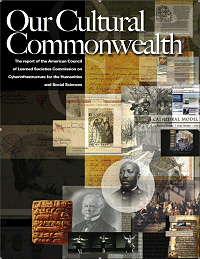
Our Cultural Commonwealth
A recent report, Our Cultural Commonwealth, from the American Council of Learned Societies (ACLS) Commission on Cyberinfrastructure for the Humanities and Social Sciences details the need for a comprehensive online infrastructure for the humanities and social sciences, the design of which should be informed by experts from those disciplines.
John Unsworth, Dean of the Graduate School of Library and Information Science at the University of Illinois, Urbana-Champaign and chair of ACLS’s Commission on Cyberinfrastructure for the Humanities and Social Sciences notes, “The humanities and social sciences have expertise in the many ways that human beings interact with information, and that expertise is key to getting this new digital infrastructure right.” Pauline Yu, president of ACLS adds, “Cyberinfrastructure is a key to the continued advancement of humanistic studies, and Our Cultural Commonwealth should serve as the guide to realizing that future.”
Supercharging the Ancients
The University of Virginia’s Institute for Advanced Technology in the Humanities (IATH) is developing a real-time 3D rendering model of the City of Rome in AD400, for use in the classroom and for research in the institute’s new 3D theater.
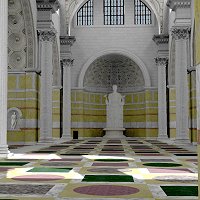
Digital model showing the Interior of the Basilica of Maxentius at Rome, property of UCLA
The model employs IBM’s Cell Broadband Engine (Cell/ B.E.), a technology that speeds up compute-intensive applications such as image processing, simulations, and gaming. UVa was one of 10 academic institutions to receive an IBM Shared University Research Award (SUR) to support research projects with Cell/B.E. Greg Humphreys, an assistant professor of computer science in the School of Engineering and Applied Science at UVa comments, “The Cell processor represents the state of the art in modern computer architecture. We’re incredibly excited to explore the potential of the new directions in high performance computing and visualization enabled by its design.”
Bernard Frischer, IATH’s director,
explains (audio file) that the Cell processor will allow the 3D model and many others to be accessed on over the Internet, available to everyone. “[The project] relates to our top priority these days, which is 3D and even 4D visualization of cultural heritage. Technology to capture works of art like statues or even important buildings and whole cities has reached the point of maturity and the price point where humanists can now make 3D models that are extremely accurate… [It’s] now a top priority of IATH to put together a great databank of these 3D models that are increasingly being made by scholars around the world in a number of disciplines.”
Federated ID Milestone
The Internet2 community demonstrated last month the interoperability of the Shibboleth federated identity management software with theNational Science Foundation’s FastLane online grant administration system used by more than 250,000 researchers, students, and faculty. The demonstration is a major step towards the use of campus identities to access online federal government resources.
Future plans include allowing an unlimited number of qualified users to access FastLane through partnerships between the US E-Authentication Identity Federation (which makes it possible for federal agencies to rely on user IDs and passwords managed by other organizations both within and outside of the federal government) and the InCommon Federation (which provides federated access for U.S. research and education institutions). Ultimately, inter-federation between InCommon and E-Authentication will mean that students, researchers, and staff throughout higher education can have easier access to a range of federal applications.